Surrogacy Cost in Kakinada (₹16–22 Lakh) | Low Cost Surrogacy Centres in Kakinada | Updated 2026
Surrogacy in Kakinada: At a Glance
- Estimated Total Cost: ₹16,00,000 to ₹22,00,000 for an altruistic surrogacy journey in Kakinada (2026).
- Legality: Only altruistic gestational surrogacy is permitted in India, strictly governed by the Surrogacy (Regulation) Act, 2021.
- What's Included: Covers IVF procedures, surrogate mother's comprehensive medical expenses, mandatory health insurance, legal formalities, and essential support allowances.
- Eligibility: Strict criteria apply for both intended parents (married Indian citizens, age limits, medical necessity) and the surrogate mother (close relative, married, 25-35 years, own child, medically fit).
- No Commercial Surrogacy: Payments to the surrogate are solely for her medical expenses, insurance, and specified support, not as a fee for carrying the pregnancy.
Surrogacy Cost in Kakinada 2026: An Overview
In Kakinada, the estimated cost for an altruistic surrogacy journey in 2026 typically ranges from ₹16,00,000 to ₹22,00,000. This estimate covers essential medical procedures, legal formalities, and the surrogate's medical expenses and insurance, adhering strictly to the Surrogacy (Regulation) Act 2021 which mandates altruistic surrogacy in India. These figures are estimates for human review and can vary based on individual medical needs, the chosen clinic, and any unforeseen complications.
What Does Surrogacy Cost in Kakinada Include?
Understanding the components of surrogacy costs is crucial for prospective parents. In Kakinada, under the altruistic surrogacy framework, the overall estimated cost generally encompasses several key aspects:
| Component | Description |
|---|---|
| Surrogate's Medical Expenses & Insurance | Covers all necessary medical tests, screenings, medications, and health insurance for the surrogate mother throughout the pregnancy, as mandated by the Surrogacy (Regulation) Act, 2021. This replaces any commercial compensation. |
| IVF Procedure Costs | Includes the In Vitro Fertilization (IVF) cycle for the intended parents, encompassing ovarian stimulation, egg retrieval, fertilization, and the subsequent embryo transfer to the surrogate. (Source: WHO) |
| Prenatal and Postnatal Care | Comprehensive medical care for the surrogate mother during the entire nine months of pregnancy, including regular check-ups, necessary diagnostic tests, and essential post-delivery care. |
| Accommodation and Caretaking | Expenses related to the surrogate's accommodation and general well-being during the pregnancy, ensuring a healthy and supportive environment. |
| Legal Fees and Documentation | Covers legal counsel, drafting of the surrogacy agreement, necessary court approvals, and all documentation required to ensure a legally sound process and secure the child's birth certificate. |
| Donor Gamete Costs (if applicable) | If donor eggs, sperm, or embryos are required for the IVF process, their procurement and associated costs are included. |
| Birth Certificate | The process and fees associated with obtaining the child's birth certificate, legally establishing the intended parents' parenthood. |
| Counseling and Support Services | Professional psychological counseling for both intended parents and the surrogate mother, providing essential emotional support throughout the journey. |
| Delivery Charges | Covers the medical expenses related to the delivery of the baby, whether vaginal or C-section. |
It is important to note that commercial surrogacy is prohibited in India by the Surrogacy (Regulation) Act 2021. Therefore, payments to the surrogate are strictly for her medical expenses, insurance, and other specified support, not as a fee for carrying the pregnancy. Always consult with an ICMR and ART-registered clinic in Kakinada for a detailed and personalized cost breakdown.
Understanding Surrogacy: A Path to Parenthood
For many couples, the dream of welcoming a child into their family is profound. However, various forms of infertility can make this journey challenging. Fortunately, advancements in reproductive medicine, such as surrogacy, offer hope. Surrogacy involves a woman, known as the surrogate mother, agreeing to carry a pregnancy for another individual or couple, referred to as the intended parents. After the child is born, the surrogate mother legally relinquishes all parental rights to the intended parents, as outlined in a formal agreement.
In India, only altruistic gestational surrogacy is permitted by law, under the Surrogacy (Regulation) Act, 2021. This means the surrogate mother carries an embryo created from the intended parents' (or donor's) gametes, thus having no genetic link to the child. The process involves several medical and legal steps, making it essential for intended parents to seek professional guidance from ICMR and ART-registered fertility clinics. For detailed information on surrogacy, you may refer to resources from the World Health Organization (WHO).
Surrogacy Treatment Options in Kakinada
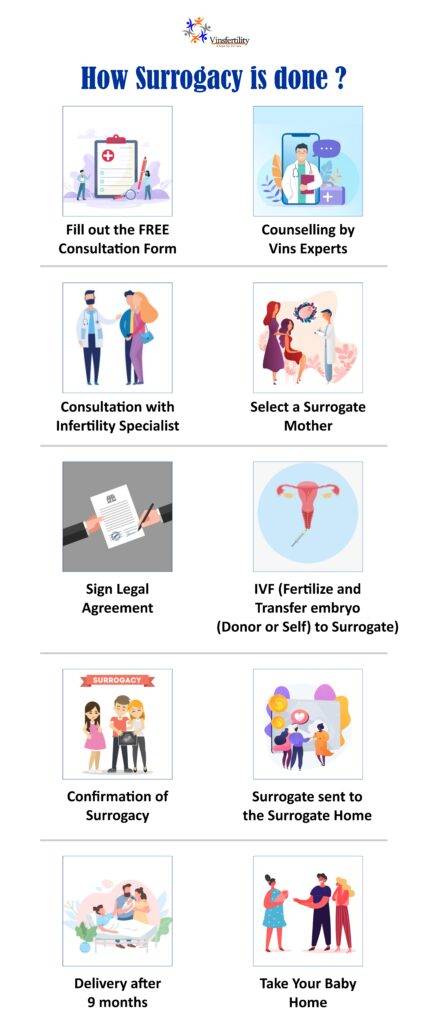
VINS Fertility is dedicated to assisting couples in Kakinada on their path to parenthood by connecting them with leading fertility clinics. We collaborate with ICMR (Indian Council of Medical Research) and ART (Assisted Reproductive Technology) Act 2021 compliant clinics across India, ensuring high standards of care and ethical practice.
If you are exploring surrogacy options in Kakinada, our network includes highly trained and experienced medical professionals who specialize in gestational surrogacy. These clinics adhere to the latest national guidelines, providing comprehensive support through every stage of the surrogacy journey, from initial consultation and medical evaluations to embryo transfer and post-delivery legal procedures.
Why Consider Surrogacy? Key Reasons and Benefits
Surrogacy can be a viable and compassionate option for individuals and couples facing specific medical challenges that prevent them from carrying a pregnancy to term. Here are some key reasons why intended parents might consider altruistic gestational surrogacy:
- Addressing Infertility Challenges: Surrogacy provides a pathway to parenthood for those struggling with various forms of infertility, including cases where the female partner cannot physically carry a pregnancy.
- Medical Necessity: It is often recommended for individuals with specific medical conditions that make pregnancy impossible or dangerously risky for their health or the baby's. These can include:
- Absence of a uterus (either congenital or due to surgical removal, e.g., hysterectomy).
- Severe uterine abnormalities (e.g., Asherman's syndrome, significant fibroids unresponsive to treatment).
- Recurrent pregnancy loss despite multiple In Vitro Fertilization (IVF) attempts with good quality embryos.
- Serious health conditions (e.g., severe heart disease, kidney disease, certain autoimmune disorders, or cancers) where pregnancy would pose a significant threat to the intended mother's life.
- Genetic Connection: Gestational surrogacy typically allows at least one, and often both, intended parents to maintain a biological and genetic connection with their child, as the embryo is created using their own gametes (sperm and egg).
- Involvement in Pregnancy: Intended parents can often be actively involved throughout the surrogate's pregnancy, attending key appointments, monitoring progress, and being present for significant milestones, including the embryo transfer and birth, fostering a strong bond.
- Higher Success Rates in Specific Cases: For specific medical indications where other fertility treatments have failed, surrogacy can offer a higher probability of a successful pregnancy and live birth, as the surrogate often has a proven track record of healthy pregnancies. For more information on reasons for surrogacy, you can consult resources from the American College of Obstetricians and Gynecologists (ACOG).
Is Surrogacy Legal in India? Understanding the 2021 Act
Yes, surrogacy is legal in India, but it is strictly regulated under the Surrogacy (Regulation) Act, 2021, and the Assisted Reproductive Technology (Regulation) Act, 2021. These acts permit only altruistic gestational surrogacy for Indian citizens.
It is crucial to understand the distinction between the types of surrogacy:
- Traditional Surrogacy: In this method, the surrogate mother's own eggs are used, meaning she is genetically related to the child. This form of surrogacy is not legalized in India.
- Gestational Surrogacy: This is the only legally accepted form of surrogacy in India. Here, an embryo is created using the gametes of the intended parents (or donor gametes) via In Vitro Fertilization (IVF) technology. This embryo is then transferred to the surrogate's uterus. The surrogate has no genetic connection to the child.
The Surrogacy (Regulation) Act, 2021, aims to prevent commercial exploitation of surrogate mothers and ensure ethical practices. It mandates that surrogacy must be altruistic, meaning no monetary compensation (beyond medical expenses and insurance) can be provided to the surrogate mother.

Eligibility Criteria for Surrogacy in India
The Surrogacy (Regulation) Act, 2021, specifies strict eligibility criteria for both the intended parents and the surrogate mother:
For Intended Parents:
- Must be Indian citizens.
- Must be a married heterosexual couple, with the wife aged between 25 and 50 years, and the husband aged between 26 and 55 years.
- Must obtain a 'Certificate of Essentiality' and a 'Certificate of Eligibility' from the appropriate authority, confirming the medical necessity for surrogacy.
- Must not have any surviving biological or adopted child, with exceptions for children with mental or physical disabilities or life-threatening disorders.
- Single Indian women who are either a widow or a divorcee, aged between 35 and 45 years, are also eligible to opt for surrogacy.
For the Surrogate Mother:
- Must be a close relative of the intended couple.
- Must be a married woman, aged between 25 and 35 years.
- Must have her own biological child.
- Must be medically and psychologically fit to carry a pregnancy, as certified by a registered medical practitioner.
- Can only act as a surrogate once in her lifetime.
- Must not provide her own gametes for the surrogacy (i.e., only gestational surrogacy is allowed).
- Must have an insurance cover for a minimum of 36 months to cover post-partum delivery complications. (Source: NCBI)
It is essential to consult with a fertility specialist and legal expert to understand all requirements and ensure compliance with the Surrogacy (Regulation) Act, 2021. Further details on the act can be found on government health portals or legal resources.
Estimated Surrogacy Cost in Kakinada 2026: A Detailed Breakdown
The estimated cost for altruistic surrogacy in Kakinada, Andhra Pradesh, for 2026 typically ranges from INR 16,00,000 to INR 22,00,000. This comprehensive estimate covers essential medical procedures, legal processes, the surrogate mother's medical expenses, insurance, accommodation, and necessary support, all while adhering strictly to the Surrogacy (Regulation) Act, 2021 of India.
VINS Fertility is committed to providing transparent and ethically compliant surrogacy options in Kakinada, adhering strictly to Indian regulations. While the surrogacy journey can be emotionally and financially demanding, we aim to simplify the process and provide clear cost breakdowns, ensuring every step is managed with utmost care and expertise.
| Surrogacy Procedure/Service | Estimated Cost Range (INR) |
| Gestational Surrogacy with Intended Parents' Gametes (Eggs & Sperm) | Rs. 16,00,000 to Rs. 19,00,000 |
| Gestational Surrogacy with Donor Eggs & Intended Father's Sperm | Rs. 17,50,000 to Rs. 20,50,000 |
| Gestational Surrogacy with Donor Sperm & Intended Mother's Eggs | Rs. 17,00,000 to Rs. 20,00,000 |
| Surrogate Mother's Medical Expenses, Insurance, and Support Allowance (as per Act) | Rs. 6,00,000 to Rs. 9,00,000 |
| IVF Cycle & Embryo Transfer Procedure | Rs. 1,80,000 to Rs. 3,50,000 |
| Surrogate Mother Screening, Preparation & Legal Formalities | Rs. 1,50,000 to Rs. 2,50,000 |
| Normal Vaginal Delivery Charges | Rs. 50,000 to Rs. 80,000 |
| Cesarean Section (C-section) Delivery Charges (if medically required) | Rs. 1,20,000 to Rs. 2,50,000 |
| Surrogate Mother's Accommodation & Nutritional Support (9 months) | Rs. 2,50,000 to Rs. 4,00,000 |
| Support Staff (Caretaker/Cook) for Surrogate Mother | Rs. 80,000 to Rs. 1,50,000 |
| Post-Delivery Care & Medications for Surrogate Mother | Rs. 30,000 to Rs. 50,000 |
| Legal Documentation & Court Procedures for Parentage Order | Rs. 1,00,000 to Rs. 2,00,000 |
| Post-Embryo Transfer Medications for Surrogate Mother | Rs. 20,000 to Rs. 40,000 |
| Gamete Donor Screening & Preparation (if applicable) | Rs. 40,000 to Rs. 70,000 |
| Post-Birth Infant Care & Initial Scans | Rs. 10,000 to Rs. 30,000 |
| Travel & Miscellaneous Allowances for Surrogate Mother | Rs. 20,000 to Rs. 50,000 |
| Embryo Freezing & Storage (Initial 6-12 months) | Rs. 15,000 to Rs. 35,000 |
| Clinic Administrative & Coordination Fees | Rs. 70,000 to Rs. 1,50,000 |
| Preimplantation Genetic Testing (PGT-A/PGT-M) for Embryos (up to 10) | Rs. 1,50,000 to Rs. 2,80,000 |
Please note: These figures are estimated ranges for 2026 and can vary based on individual medical needs, clinic policies, and any unforeseen complications. It is crucial to have a detailed discussion with your fertility specialist regarding the exact cost breakdown for your specific surrogacy journey. No ethical clinic can guarantee a pregnancy or live birth.
To know more about Surrogacy cost in Kakinada, you can speak with our fertility experts, who will guide you throughout the Surrogacy process.
Factors Influencing Surrogacy Costs in Kakinada
While the estimated cost range provides a general guideline, several factors can influence the final expense of altruistic surrogacy in Kakinada:
- Number of IVF Cycles: If multiple IVF attempts or embryo transfers are needed to achieve a successful pregnancy, the overall cost may increase.
- Donor Requirements: The need for donor eggs, sperm, or embryos, if the intended parents cannot use their own gametes, can add to the total cost.
- Advanced Genetic Testing: Inclusion of procedures like Preimplantation Genetic Testing (PGT-A/PGT-M) for embryo screening, which adds to the cost. PGT-A (Aneuploidy) screens for chromosomal abnormalities, while PGT-M (Monogenic) screens for specific genetic diseases.
- Delivery Method: A Cesarean section (C-section) typically costs more than a normal vaginal delivery.
- Medical Complications: Any unforeseen medical complications for the surrogate or the baby during pregnancy or delivery may incur additional medical expenses not covered by the standard package.
- Clinic Charges: Fees can vary slightly between ICMR-registered fertility clinics in Kakinada based on their facilities, infrastructure, and specific service packages.
- Legal Complexities: While standard legal fees are included, unusual legal complexities or additional legal advice might lead to extra charges.
Frequently Asked Questions
Is surrogacy legal in Kakinada, and who is eligible under Indian law?
Yes, altruistic surrogacy is legal in India under the Surrogacy (Regulation) Act, 2021. Eligibility is restricted to infertile, heterosexual Indian married couples who meet specific medical and age criteria, and single Indian women (widows/divorcees) between 35-45 years of age. Commercial surrogacy is strictly prohibited in India. You can find detailed eligibility criteria on the National ART and Surrogacy Portal.
What is the estimated cost of surrogacy in Kakinada for 2026?
The estimated total cost for an altruistic surrogacy process in Kakinada for 2026 typically ranges from approximately ₹15,00,000 to ₹25,00,000. This is an estimated range and can vary significantly based on the specific medical procedures required, the chosen clinic, and any unforeseen medical complications.
What factors influence the total surrogacy cost in Kakinada?
The total cost of surrogacy in Kakinada is influenced by several factors, including the specific medical treatments involved (e.g., number of IVF cycles), the surrogate mother's compensation, her nine months of accommodation and care, legal fees, and administrative charges. Additional medical needs, such as donor gametes or advanced embryo testing, can also affect the overall expenses.
What is typically included in the surrogacy cost package in Kakinada?
A comprehensive surrogacy package in Kakinada generally includes the surrogate mother's compensation, her medical expenses, nine months of accommodation and nutritional support, legal documentation, and the IVF procedure costs. It also covers antenatal care, delivery charges, and necessary post-delivery care for the surrogate, though specific inclusions can vary by clinic.
How long does the surrogacy process typically take in Kakinada?
The entire surrogacy journey in Kakinada, from the initial consultation and legal formalities to the birth of the child, can typically take between 15 to 20 months. This timeline includes finding a suitable surrogate, comprehensive medical screenings, legal clearances, the IVF cycle, the nine-month pregnancy, and post-delivery legal and administrative formalities.
Can a surrogacy clinic in Kakinada guarantee a live birth?
No, no surrogacy clinic in Kakinada or anywhere can guarantee a live birth. While medical advancements have significantly improved success rates in assisted reproductive technologies, the outcome of any biological process, including surrogacy, depends on various factors and cannot be 100% guaranteed. The World Health Organization (WHO) emphasizes that fertility treatments involve probabilities, not certainties.
How can I choose a genuine and registered surrogacy centre in Kakinada?
To choose a genuine and legally compliant surrogacy centre in Kakinada, ensure that the clinic is registered under the Assisted Reproductive Technology (Regulation) Act, 2021, and the Surrogacy (Regulation) Act, 2021. You can verify the registration status of clinics on the National ART and Surrogacy Portal. It is crucial to consult with multiple registered clinics, thoroughly review their credentials, and clearly understand their legal and medical protocols before making a decision.
Sources & References
- The Surrogacy (Regulation) Act, 2021 — Government of India
- Indian Council of Medical Research (ICMR) — National ART & Surrogacy Registry
- NABL — National Accreditation Board for Testing and Calibration Laboratories
- World Health Organization (WHO) — Infertility clinical guidance
- PubMed — Peer-reviewed fertility research (NIH/NLM)
All external sources link to primary government, medical, or peer-reviewed material. This article is reviewed by a qualified fertility specialist and updated as clinical guidance changes.