IVF Cost in Surat (2026): ₹1,01,500 – ₹2,35,500 Per Cycle
In and around Surat for 2026, the estimated cost for a single In Vitro Fertilization (IVF) cycle typically ranges from ₹1,01,500 to ₹2,35,500, with third-party estimates for the city citing a wider ₹90,000–₹2,10,000 band excluding medicines and injections, and some independent guides putting an average single cycle closer to ₹1,10,000–₹2,20,000. Surat is one of Gujarat's fastest-growing cities and has developed a correspondingly deep fertility-care market — this guide from Vinsfertility clarifies the expected expenses and what influences them.
Why Surat IVF Costs Sit Where They Do
Surat's fertility sector has grown alongside the city itself: genuinely old, family-run maternity and IVF hospitals with 25–50 years of history sit next to a wide spread of national chains (Nova IVF, Banker IVF) and independent multi-branch groups (Candor IVF, operating since 2009) that have expanded across the city's Vesu, Adajan, Katargam, and Kapodra neighbourhoods. That mix of clinic age and scale is a big part of why quoted prices vary so widely from one Surat centre to another.
- Long-established local expertise: Several Surat fertility specialists have 15–30+ years of practice, including doctors trained abroad (Germany, England, Australia) in IVF and endoscopy.
- City-scale competition: Multi-branch independent groups (Candor IVF, Bavishi Fertility Institute) and national names (Nova IVF, Banker IVF — expanding from its established Ahmedabad base) compete directly with older single-location hospitals (Rupal Hospital, reportedly with a 50-year legacy; the Paaranu Center, established 1996).
- Technology and lab quality: Centres advertising international-level embryology labs and advanced protocols (ICSI, IMSI, PGD, blastocyst culture) typically charge more than basic setups.
- Regulatory compliance: Compliance with the ART (Regulation) Act, 2021 and registered ART centres requires investment in equipment and ethics oversight.
What a "Base Cycle" Price Does and Does Not Include
Included in a Typical Base IVF Cycle
- Initial consultation and medical history review.
- Basic ovarian stimulation monitoring (ultrasounds, hormone tests).
- Egg retrieval procedure (including basic theatre/anesthesia charges).
- Sperm preparation.
- Standard fertilisation (IVF) in the lab.
- Embryo culture and embryo transfer into the uterus.
Common Exclusions from a Base IVF Cycle
- Hormone medications and injections — the single biggest swing factor in most Surat quotes.
- Advanced fertilisation techniques such as ICSI, IMSI or PICSI.
- Embryo freezing and annual storage charges — cost varies by number of eggs, storage time, and process.
- Preimplantation Genetic Testing (PGT/PGD) costs.
- Donor egg, donor sperm, or donor embryo services.
- Additional diagnostic tests such as hysteroscopy, TESA/PESA/TESE, or sperm DNA fragmentation.
Full IVF Cost Breakdown in Surat: Every Line Item Explained
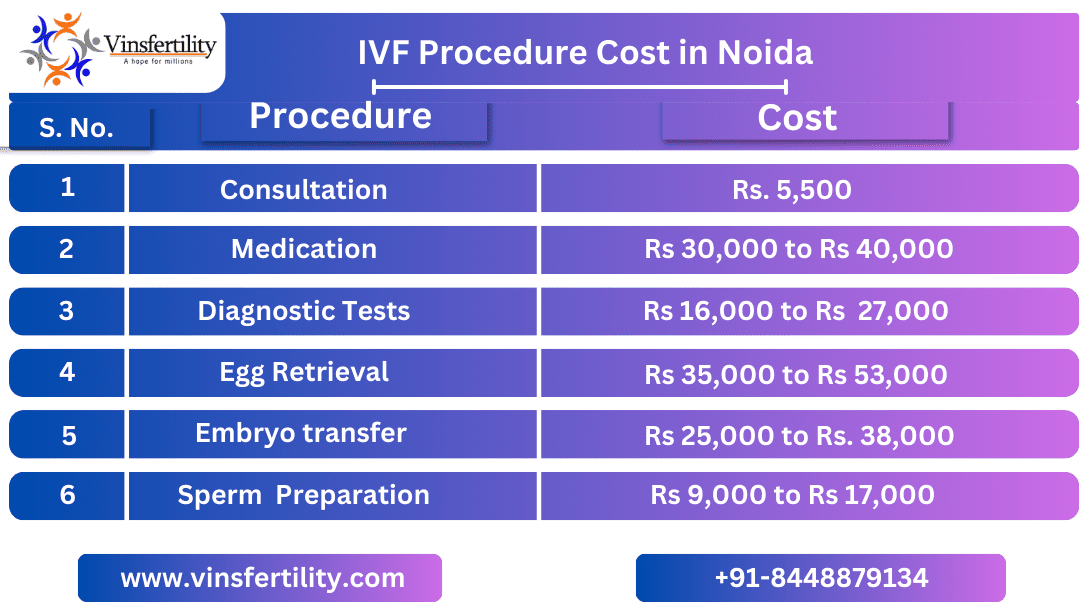
| Item | Estimated Range (₹) | Notes |
|---|---|---|
| Initial Consultation | 500–1,500 | First meeting, history review, counselling |
| Diagnostic Tests (Female) | 8,000–20,000 | Hormone assays, infection screenings, blood work |
| Diagnostic Tests (Male) | 3,000–8,000 | Semen analysis, hormonal/infection tests if indicated |
| Ultrasound Monitoring | 5,000–15,000 | Tracks follicle growth and endometrial thickness |
| Ovarian Stimulation Drugs | 40,000–1,00,000+ | Varies by dosage, duration, protocol and brand |
| Egg Retrieval | 30,000–60,000 | Includes anesthesia and theatre charges |
| Sperm Preparation | 5,000–10,000 | Isolating healthy, motile sperm |
| Fertilisation (Standard IVF) | Included in base cycle | Standard insemination/IVF |
| ICSI (add-on) | 20,000–35,000 | Added when male-factor infertility is diagnosed |
| Embryo Culture | Included in base cycle | 3–5 day monitoring to blastocyst stage |
| Embryo Transfer | 25,000–45,000 | Placement of embryo(s) into uterus |
| Embryo Freezing & Storage | Varies by duration | Depends on number of eggs, storage time, and storing process |
| IUI (for comparison) | 6,000–40,000 | Cost rises with number of cycles and case complexity |
| Embryo Donation | 1,00,000–3,00,000 | For couples uncertain about proceeding after multiple failed cycles |
Hidden Costs Most Clinics Don't Advertise Upfront
- Advanced diagnostic tests (karyotyping, hysteroscopy, sperm DNA fragmentation).
- Post‑transfer medications (progesterone and luteal support).
- Anesthesia for additional minor procedures.
- Blastocyst culture surcharges (Day 5/6 vs Day 3).
- PGD/PGS embryo biopsy and testing costs.
- Extended counselling sessions.
- Donor sourcing, legal, and screening fees.
- Emergency management costs, such as OHSS hospitalisation.
Medication Cost Swing Based on Age and Ovarian Response
Medication costs can vary widely based on age, ovarian reserve/response (AMH levels, PCOS), treatment protocol (antagonist, long agonist, mild stimulation), and drug brand. Younger women with good reserve may need lower doses, while older patients or complex cases may require higher‑intensity stimulation. Surat guides consistently list medication dosage as one of the top factors — alongside number of cycles needed and treatment method chosen — driving the overall price a couple ultimately pays.
IVF Success Rates in Surat: What to Realistically Expect
Surat's more established centres report headline success rates as high as 75% per self-cycle and 85% per donor-cycle for younger women (21–35), broadly in line with figures cited for younger age groups nationally — though these are best read as clinic-reported ceilings rather than guaranteed outcomes for every patient. It's important to understand that IVF success is strongly age‑dependent: fertility gradually declines with age, especially from the mid‑30s onward, and more rapidly after 37, mainly due to egg quantity and quality. A realistic, age‑adjusted expectation — discussed openly with your fertility specialist — is more useful than a single headline percentage, and any clinic's advertised rate should be checked against independently reported, age-specific live-birth data.
Factors Influencing IVF Success Rate in Surat
- Number of IVF cycles required
- Experience of the doctor and embryology team performing the treatment
- Age of the patient
- Underlying cause(s) of infertility
- Duration of infertility
- Quality of egg, embryo, and sperm
- Lifestyle habits such as smoking and alcohol use
- Endometrial development and receptivity
- Type of infertility — primary or secondary
IVF Cost by Treatment Type: IVF vs ICSI vs Mini‑IVF
| Procedure | Estimated Price Range (₹) | Best Suited For |
|---|---|---|
| Conventional IVF (Basic) | 90,000–2,10,000 | Unexplained infertility, mild male factor, tubal blockage |
| IVF with ICSI | 1,50,000–2,50,000 | Severe male factor infertility, previous fertilisation failure |
| IVF with PESA/TESA/TESE | 2,50,000–5,00,000 | Surgical sperm retrieval for azoospermia or severe male infertility |
| IUI (for comparison) | 6,000–40,000 | First-line treatment for mild infertility, often tried before IVF |
When ICSI is Medically Justified vs. Potentially Upsold
ICSI is medically justified in cases of severe male factor infertility, prior fertilisation failure, or frozen sperm use. If ICSI is recommended without a clear male‑factor indication, couples should ask why it is needed, as some clinics may offer it routinely as an upsell add‑on.
Cost of Donor Egg, Donor Sperm, and Donor Embryo Cycles
- Donor egg cycle: Priced above a standard self-egg cycle, since the donor undergoes the full stimulation and retrieval process herself; always request an itemised quote.
- Donor embryo cycle: Typically ₹1,00,000–₹3,00,000, an option some couples consider after multiple unsuccessful IVF attempts with their own gametes.
- Surrogacy: As with other Indian cities, clinics generally cannot arrange a surrogate themselves — couples typically need to bring their own surrogate for the clinic to work with, subject to the Surrogacy (Regulation) Act, 2021.
Donor gametes and embryos should always be sourced through registered ART banks that follow the ART and Surrogacy regulations for safety and ethical screening.
Add-On Procedure Costs: PGT, Laser Hatching, Blastocyst, FET
PGT-A / PGD Pricing Per Embryo
PGT‑A/PGD screens embryos for chromosomal abnormalities or specific genetic disorders. Costs are usually around ₹25,000–₹50,000 per embryo, in addition to biopsy and lab fees — several Surat centres list PGD alongside ICSI, IMSI, and blastocyst culture as part of their advanced-treatment menu.
Frozen Embryo Transfer (FET) Cost vs. Fresh Transfer
A straightforward FET (thawing, endometrial preparation, transfer only) is generally cheaper than a fresh cycle since it skips stimulation and egg retrieval. Several Surat centres list FET alongside ICSI and IMSI as a standard advanced-treatment offering — always clarify whether a quoted figure is FET-only or bundles a fresh stimulation cycle.
Laser-Assisted Hatching (LAH)
Laser-assisted hatching is offered as a standard add-on at several Surat centres to aid embryo implantation — confirm whether it's included in your base package or billed separately.
Low-Cost IVF in Surat: How to Genuinely Reduce Your Bill
- Compare local centres directly: Surat has enough genuinely long-established, independent options — plus national chains and multi-branch groups — that comparing quotes is worthwhile before committing to any one clinic.
- Ask what "package" actually includes: Given how differently embryo freezing, ICSI, and medication are billed across Surat clinics, always confirm exactly what's bundled into a quoted number.
- EMI and No-Cost EMI options: Several Surat clinics now advertise no-cost EMI plans; always check interest, processing fees, and terms in writing.
- Multi‑cycle packages: Some centres offer discounted multi-cycle packages (for example, "triple-cycle" bundles); clarify what counts as one "cycle" and refund rules.
- Weigh total cost, not just per-cycle price: Since most couples in Surat need two to three cycles on average, a clinic with a meaningfully higher success rate can work out cheaper overall than a lower-priced clinic needing more attempts.
Fertility Centres Serving Surat Patients
Surat has multiple real, dedicated fertility centres located within the city itself, including some with multi-decade histories. Below are centres with address and doctor details verified where possible.
1. Rupal Hospital, Surat
Reported as carrying a 50-year legacy in women's healthcare and maternity/IVF services in the city.
Doctor: Dr. Rupal — specialises in advanced infertility treatment and IVF, with training from various national and international institutes; reported as a faculty member at academic conferences and seminars per the hospital's own materials. Specific address and additional credentials weren't independently confirmable beyond the hospital's own listing — confirm directly with the centre.
2. Nova IVF Fertility, Sagarampura
A branch of the Nova IVF Fertility chain, reporting over 15 years of experience and more than 8,000 IVF pregnancies delivered.
Address: No. 2763/A, Ground and First Floor, Seven Square Doctor House, Sagarampura, Majuragate, Surat, Gujarat – 395002
Doctor: Dr. Mona Shroff, per patient reviews on the centre's own listing; specific credentials and years of individual experience weren't independently confirmable — confirm directly with the centre.
3. Bavishi Fertility Institute, Lal Darbaja
An independent fertility institute offering multi-cycle packages including a "Triple-cycle" and "Suraksha Kavach" package.
Address: Param Doctor House, Lal Darbaja, Surat, Gujarat
Doctors: Dr. Deep Gajiwala and Dr. Disha, per the centre's own patient-facing materials; specific degrees and years of experience weren't independently confirmable — confirm directly with the centre.
4. Banker IVF, Surat (branch of the Ahmedabad-founded practice)
An expansion into Surat of a fertility practice originally established in Ahmedabad, where it is described as one of India's most trusted fertility names.
Doctor: Dr. Manish Banker — Founder. Reported nearly 30 years in the field and involvement in over 30,000 successful IVF pregnancies across the practice; IVF and endoscopy training reported in Australia and Germany. Also associated with the Surat team: Dr. Bhijal, per the practice's own materials. Specific Surat clinic address wasn't independently confirmable — confirm directly with the practice.
A note on this list: unlike the cost table above, package pricing, patient ratings, and clinic-specific success rates for these centres aren't published anywhere in a verifiable, standardised form, so exact figures per clinic haven't been made up here to fill that gap. Where a doctor's specific degree, address, or years of experience wasn't fully confirmable, that's flagged rather than guessed. Always get a written, itemised quote and current doctor/success‑rate details directly from the clinic, and double‑check the address before travelling, since branches and consultants can change. For help comparing options across centres serving Surat, appointment enquiries can be routed through the Vinsfertility patient‑concierge line.
Why IVF Costs Vary Across Clinics That Serve Surat
- Decades-old independent hospital vs. national chain vs. multi-branch group: A long-established, single-city hospital (like Rupal Hospital) may price and package differently than a branch of a national chain (Nova IVF, Banker IVF) or a locally grown multi-branch group (Candor IVF, Bavishi Fertility Institute).
- Doctor experience tier: Surat's fertility scene spans doctors from roughly 7 years to 30+ years of experience — more senior specialists, especially those with international training, often command higher fees.
- Embryology lab quality: International-level embryology labs and advanced techniques (ICSI, IMSI, PGD, blastocyst culture) raise both success rates and fees.
- Neighbourhood spread: Surat's fertility clinics are spread across Vesu, Adajan, Katargam, Kapodra, Sagarampura, and the Kadodara/Kadodara-adjacent belt, with pricing and positioning varying by area.
How to Choose a Premier Fertility Clinic
| What to Verify | What to Check | Why It Matters |
|---|---|---|
| ART Act, 2021 registration | Clinic/centre registered as per ART regulations | Ensures patient safety and ethical practice |
| National ART Registry listing | Centre listed on the National ART & Surrogacy Registry | Confirms legitimate registration status |
| Embryology lab standards | Lab certifications, equipment quality, and sterility | Directly impacts embryo development and success rates |
| Live‑birth rate transparency | Clinic shares age‑specific live‑birth rates, not just pregnancy rates | Gives realistic outcome expectations |
| Andrology setup | Proper male fertility diagnostics and sperm processing | Critical for male factor infertility cases |
| Counsellor availability | Access to psychological support and counselling | Helps couples cope with emotional aspects of treatment |
Red Flags to Watch Out For
- Guaranteed pregnancy claims — no IVF treatment can be 100% guaranteed.
- Opaque billing, vague "package deals", or unexpected mid‑treatment charges.
- Unregistered centres not listed on relevant ART and fertility registries.
Questions to Ask Before Signing Consent and Payment Forms
- Request a detailed, itemised cost breakdown, including cancellation or repeat‑attempt terms.
- Ask for clinic‑specific live‑birth rates for your age group and diagnosis.
- Inquire about embryology lab credentials and embryologist qualifications.
- Clarify embryo storage, disposal, and annual fee policies.
- Confirm availability of counselling and psychological support.
- Understand emergency protocols (e.g., OHSS management).
- If applicable, verify donor gamete sourcing/screening compliance with ART Act, 2021, and ask directly whether the clinic can help arrange a surrogate or only work with one you bring yourself.
Frequently Asked Questions about IVF Cost in Surat
1. What is the average IVF cost in Surat in 2026?
The average IVF cost for a standard cycle in Surat is usually between ₹1,01,500 and ₹2,35,500, though third-party estimators quote a wider ₹90,000–₹2,10,000 range excluding medicines and injections. Always ask for a written, itemised estimate.
2. Does the IVF package in Surat include medicines and tests?
Most base IVF packages cover consultations, monitoring, egg retrieval, sperm preparation, fertilisation, and embryo transfer. Hormone injections, blood tests, embryo freezing, and add-ons such as ICSI, IMSI, or PGD are often billed separately and should be clarified in advance.
3. Why do IVF costs vary between different clinics serving Surat?
Costs vary due to differences in lab technology, doctor and embryologist experience, whether the clinic is a decades-old independent hospital, a national chain, or a locally grown multi-branch group, and the types of services included. More senior, internationally trained specialists often charge higher consultation and package fees.
4. How many IVF cycles might be needed to get pregnant?
On average, couples in Surat go through two to three IVF cycles, though some conceive in a single attempt. Age, diagnosis, egg and sperm quality, previous treatment history, and lifestyle factors all play a role. Your fertility specialist can suggest a realistic plan after reviewing your case.
5. Are EMI or financing options available for IVF in Surat?
Several Surat clinics now advertise no-cost EMI plans for IVF treatment. Before signing, check interest rates, processing fees, eligibility criteria, and written terms to understand the true long-term cost.
Summary
Vinsfertility connects couples from Surat — one of Gujarat's fastest-growing cities with a correspondingly deep and varied fertility-care market — with trusted IVF and fertility centres that follow ethical practice, modern technology, and transparent pricing. Through experienced fertility experts, doctors, counsellors, and support teams, we help intended parents understand their options, compare centre‑specific costs, and make informed decisions about treatment.
Sources & References
- The Surrogacy (Regulation) Act, 2021 — Government of India
- Indian Council of Medical Research (ICMR) — National ART & Surrogacy Registry
- NABL — National Accreditation Board for Testing and Calibration Laboratories
- World Health Organization (WHO) — Infertility clinical guidance
- PubMed — Peer-reviewed fertility research (NIH/NLM)
All external sources link to primary government, medical, or peer-reviewed material. This article is reviewed by a qualified fertility specialist and updated as clinical guidance changes.